SaaS
Slavena V.
How to choose a Design Agency for your SaaS Product
1. The real problem
Choosing a design agency sounds simple on paper, but in reality, it’s one of those decisions that quietly carries a lot of weight. You’re not just picking a vendor — you’re deciding how your product will be understood by people who have never seen it before.
Most agencies present themselves well. The portfolios are polished, the case studies are convincing, and the conversations feel reassuring. And yet, many founders still walk away from these projects feeling like something didn’t quite land.
Good design doesn’t just make things look better.
It makes things make sense faster.
2. Start with the outcome
It’s easy to begin with deliverables — a new website, a rebrand, better UX.
But those are outputs. What actually matters is what needs to change.
Take a step back and define:
– Where are users getting confused?
– What’s hard to explain today?
– Where are you losing people?
– What would success look like in a few months?
If this isn’t clear, no agency can fix it.
👉 A strategy or product audit is often the fastest way to get clarity before committing.
3. Different agencies, different jobs
“Design agency” is a broad label.
In reality, you’re choosing between different ways of solving problems:
– some focus on visuals
– some focus on product logic
– some focus on clarity and positioning
Most are strong in one area — not all three.
That’s where mismatches happen.
4. When visuals are enough
If your product already makes sense and your main issue is perception, visual design can go a long way.
You’ll likely get:
– a stronger brand presence
– cleaner UI
– more polished assets
That alone can improve trust.
But if people don’t understand your product, design will only make that confusion more refined — not less.
5. When product thinking matters
As products grow, complexity follows.
More features, more edge cases, more friction.
Product-focused teams help simplify that by improving:
– onboarding
– navigation
– core flows
These changes reduce friction — even if they’re not always visible at first glance.
6. Why strategy matters
Before anything is designed, there’s a layer of thinking that shapes everything.
How you position your product.
What you emphasize.
What you leave out.
This is where strategy-led teams focus.
They help define:
– who you’re speaking to
– what matters most to them
– how your product should be understood
👉 This usually sits within a branding and strategy phase — and it’s often where the biggest gains happen.
7. Subtle red flags
Most agencies won’t show obvious warning signs.
But small signals matter:
– starting with visuals before understanding your audience
– offering multiple directions without a clear recommendation
– “unlimited revisions” without structure
– no discussion of outcomes or metrics
These often point to surface-level work.
8. What good feels like
When the fit is right, the process feels different.
There’s direction. Decisions feel grounded.
A strong partner will:
– challenge your thinking
– explain why decisions are made
– simplify complexity
– stay focused on outcomes
The goal isn’t to impress you.
It’s to make things obvious for your users.
9. How much does a design agency cost?
Typical ranges in 2026:
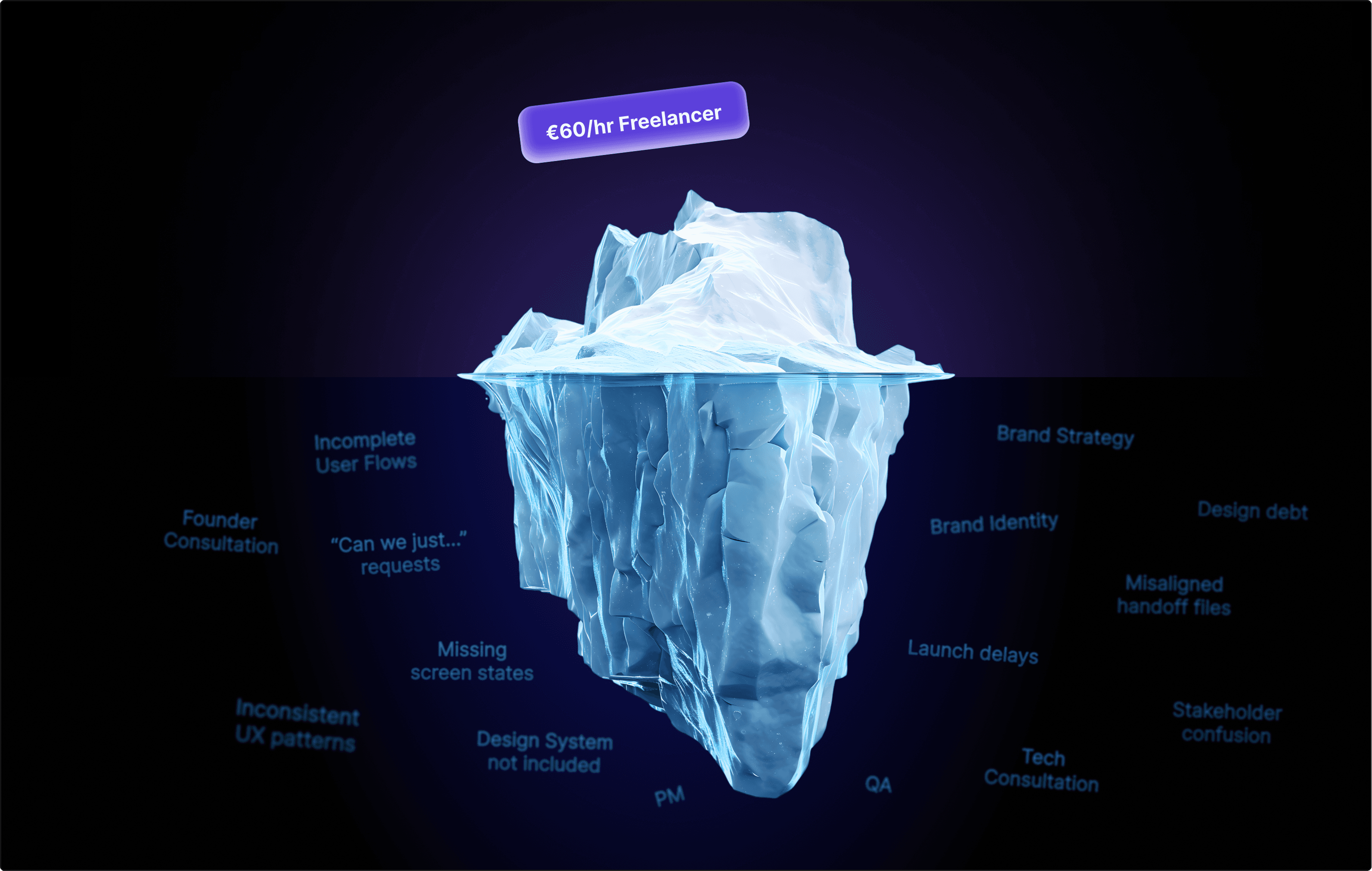
€5k–€15k → freelancers or small branding
€15k–€50k → boutique agencies
€50k–€150k+ → top-tier product and brand
The real question isn’t cost.
It’s how expensive it is to get it wrong.
Because you’re choosing how clearly your product communicates, how fast users understand it, and whether they trust it in the first five seconds.
Most founders don’t need more design. They need better decisions, made earlier.