Digital health app design for Europe and the US
Digital health app design for Europe and the US: one core product with local layers for language, units, dates, consent and trust cues.
26 Oct 2026
Looking for a climate tech design agency? Eight studios with real climate and energy work, the criteria we used and what to ask before you hire.

Climate tech design agencies with real climate or energy work to show include fuseproject, How&How, Bakken & Bæck, Ramotion, Kontrapunkt, Dtail Studio, Branx and Lippincott. They differ by stage, by hardware or software, and by where they’re based. Pick the one whose climate case study looks most like your company, then ask who did the work.
Climate tech raised $40.5bn in venture and growth money in 2025, up 8% on 2024, according to CTVC’s analysis of Sightline Climate data. The number of deals fell 18% to 1,545, and seed deal counts fell 19%.
More money, fewer deals. The startups that get the meeting explain a hard technology in seconds, and a lot of that is design.
Plenty of studios now have a climate page. Fewer have climate work. This list only includes studios that show it.
Disclosure: Dtail Studio publishes this blog and is listed below in the same format.
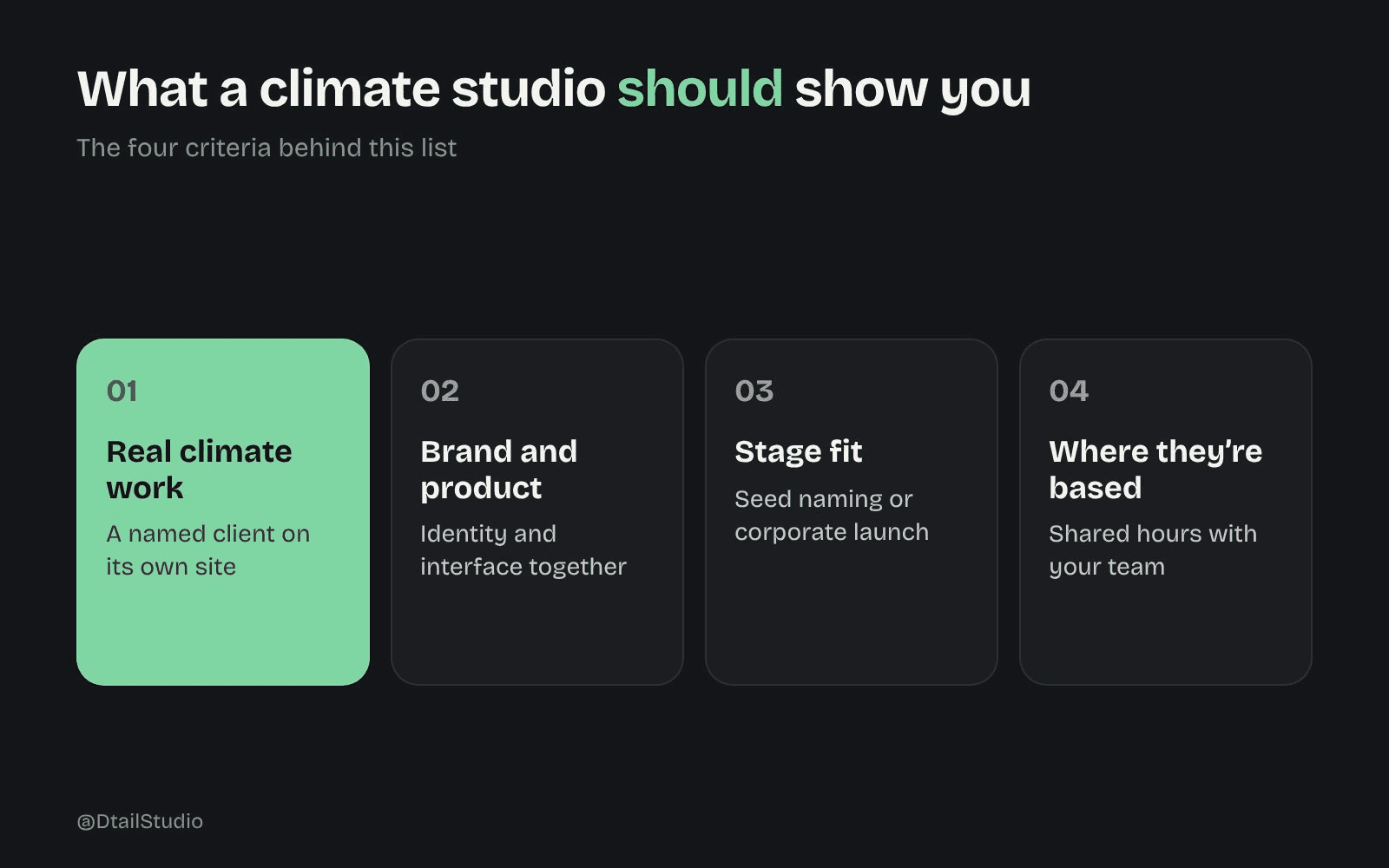
The criteria used to pick the studios in this list. Framework by Dtail Studio.
Real climate or energy work you can open, brand and product skills in the same team, experience at your stage, and a location that works for you. These are the criteria we used:
Real climate work shown.
A case study on the studio’s own site with a named climate or energy client. A services page alone didn’t count.
Brand and product both.
Most climate startups have to explain a technology and then let people use it, through a dashboard, an app or a device. One team doing both keeps the story consistent.
Startup stage fit.
Naming a seed company is different work from launching a corporate venture.
Where they’re based.
For US founders that means shared hours, US clients and who joins a live call.
These eight, in no ranked order, each with climate or energy work on its own site.
fuseproject, San Francisco.
Who they are: Yves Béhar’s industrial design studio. Climate work shown: its climate tech page features Maximo, an AI-enabled solar installation system for AES, and cites 50% faster panel installation at 50% lower cost from that case study. Good fit for: hardware startups that need the device, its interface and the story designed together.
How&How, London and Los Angeles.
Who they are: a branding studio covering strategy, identity and digital. Climate work shown: Meteoric, a German AI-powered B2B energy supplier: name, strategy, identity and website, from a blank page. In 2022 it also ran GetSet, a pro bono branding programme for climate startups. Good fit for: early-stage teams that need a name and a brand from zero.
Bakken & Bæck, Oslo, Amsterdam, Bonn, London and Barcelona.
Who they are: a design and technology studio. Climate work shown: Carbo Culture, a carbon removal company: an identity drawn from carbon’s hexagonal structure, custom diagrams and renders, and a website the studio also built. The page notes Carbo Culture raised $18 million shortly after launch. Good fit for: deep tech companies that need a hard technology made visible, with design and build in one team.
Ramotion, San Francisco, Los Angeles and New York.
Who they are: a branding and UI design agency. Climate work shown: Stable, a San Francisco platform that models and tracks EV charging sites: positioning and identity, followed by UI and web app work according to the client’s feedback on the page. Good fit for: US software startups in energy and EV infrastructure.
Kontrapunkt, Copenhagen and Tokyo.
Who they are: a brand and design agency. Climate work shown: Clever, Denmark’s largest EV charging network: a new identity, a digital design system linking chargers and interfaces, and motion. Good fit for: companies with a physical network and an app that need one brand across both.
Dtail Studio, Barcelona and California.
Who they are: a brand and product design studio working mostly with HealthTech and renewable energy startups. Climate work shown: Cubee, an energy management startup: brand strategy, identity, packaging and product design, in the Cubee case study. Cubee has 2,000+ installations. Good fit for: energy startups that need brand and product designed as one system.
Branx, Spain.
Who they are: a branding and web design agency for startups. Climate work shown: Enlitia, a Portuguese cleantech startup building analytics for energy companies: naming, strategy, identity, website and an explainer video. Good fit for: seed-stage software startups that need a name, a brand and a website together.
Lippincott, New York, San Francisco, London and other cities.
Who they are: a large brand consultancy. Climate work shown: Elimini, a carbon removals brand created for Drax: naming, strategy, identity and launch. Good fit for: corporate climate ventures and large energy companies, more than seed-stage startups.
Start with what you sell: hardware, software, or a market people don’t understand yet.
Hardware.
Pick a studio that has shipped physical products, or one that designs brand, packaging and product together.
Software and data.
Look for interface screens in the case study, not only an identity. Ask to see a dashboard.
A new category.
Carbon removal and new energy markets need explaining before persuading. See how each studio made the technology visible.
Stage and size.
Seed teams need speed and a name. Corporate ventures need a launch across many markets.
Our view: be wary of any studio that pitches leaves, globes and green gradients. Climate buyers are utilities, installers and CFOs, and the brands that win them look like dependable infrastructure. Our post on how to brand a clean energy startup covers the brand side, and nobody understands a kilowatt-hour the product side. If you’re a US team weighing a studio abroad, read hiring a European design agency as a US startup.
Ask questions only a studio with real climate experience can answer well.
Which climate project is closest to ours, and who on today’s team worked on it?
How did you check the technical and environmental claims in that work? The FTC’s Green Guides exist to help marketers avoid environmental claims that mislead, and a good studio raises them before your lawyer does.
What did you design beyond the identity: website, product interface, packaging, deck?
Who will we talk to in US working hours?
What did the client keep using after launch, and what did they change?
We’d start with the technology and make sure we can explain it in one sentence before we design anything.
A technical walkthrough.
Your engineers explain the product to us the way they would to a new hire.
A one-sentence story.
What it does, for whom, and why now, tested on someone outside the industry.
Brand and product from the same parts.
Identity, key screens or device surfaces, and the deck, built as one system.
A claims check.
Every number and environmental claim on the site and in the deck traced to its source.
A handover your team can run.
Guidelines, components and source files.
Bring your latest deck, technical documents and the questions buyers asked last time. More on how we work.
Do I need a climate specialist studio?
Not always. You need one that has explained a hard technology clearly. Climate work on its own site is the fastest proof.
Can one studio do brand and product?
Several on this list show both. Ask to see screens from the same project as the logo.
Should a US climate startup hire a studio in Europe?
It can work well with written feedback and a few shared hours a day. Check who covers US hours.
How do I check a studio’s climate work is real?
Open the client’s own website and see if the work is live.
Put your homepage and your deck side by side. Show each to someone outside climate for ten seconds, then ask what your company does. If the two answers differ, you have the first brief for any studio on this list.
If you’d like a second opinion on that brief, let’s talk.
About the author: Alma Johnson is Content Lead at Dtail Studio and writes about brand strategy, positioning and how founders explain what they do.
Sources: CTVC by Currence, $40.5bn and 8% uptick as power demand drives ’25 investment (January 2026, Sightline Climate data), Federal Trade Commission, Green Guides, fuseproject, Climate tech product design and commercialisation, Dezeen, BlueFocus to acquire Yves Béhar’s fuseproject (July 2014), How&How, Meteoric, TypeRoom, GetSet: How&How’s climate-first programme (2022), Bakken & Bæck, Carbo Culture, Ramotion, Stable branding, Kontrapunkt, Clever, Branx, Enlitia, Lippincott, Elimini
Digital health app design for Europe and the US: one core product with local layers for language, units, dates, consent and trust cues.

Thinking of a design agency in Europe for your US startup? Real cost and time-zone numbers, what the contract should cover, and when to stay local.

HealthTech pitch deck design: show who pays, your evidence, a one-line regulatory path and how patient data is handled. What investors look for.