Digital health app design for Europe and the US
Digital health app design for Europe and the US: one core product with local layers for language, units, dates, consent and trust cues.
26 Oct 2026
Thinking of a design agency in Europe for your US startup? Real cost and time-zone numbers, what the contract should cover, and when to stay local.

Yes, for most US startups, as long as the work is set up for the time difference. A design agency in Europe can give a US startup a senior team at a lower hourly cost, with about three shared working hours with New York. It’s a weaker fit when the product needs daily live workshops with US users.
It’s 09:00 in New York and 15:00 in Barcelona. By the time your team has finished its first coffee, the studio has had most of a day on your onboarding flow, and the review is the first thing in your calendar.
That’s the good version. The bad version has the same six hours, nobody deciding who reviews what, and a week lost to “quick syncs” half the team can’t attend.
Which version you get depends on setup. Start with price, because it’s simpler than it looks.
It’s a good idea when you want more senior people for your budget and your team can work asynchronously most of the week. Good European studios have worked with US clients for years and already run their week around the gap. Written briefs, recorded walkthroughs and clear sign-offs are habits worth having anyway.
It’s a bad idea when the cheapest quote is the only reason. A studio that costs a third less and takes twice as long to get a decision out of you spends more of your runway. Our post on the wrong type of design agency covers the bigger mismatch: a good studio hired for the wrong kind of work.
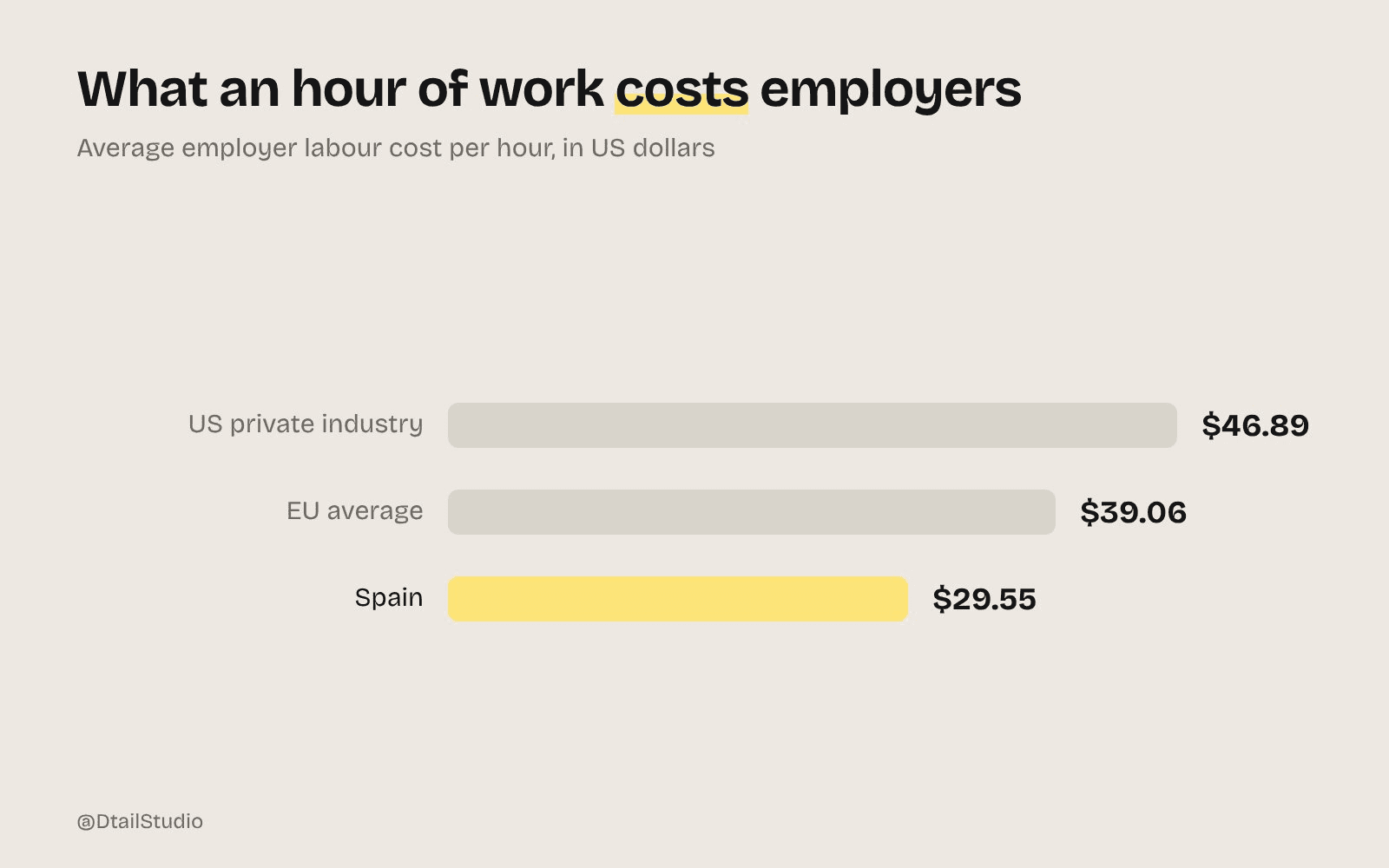
Average employer labour cost per hour, whole economy, not design-specific. EU and Spain converted at the ECB rate of 23 October 2026. Source: BLS, September 2026; Eurostat via Forbes España, March 2026; ECB, October 2026.
Usually less per hour, because people cost less to employ in most of Europe, though the gap is smaller than many founders expect. Two sets of official figures give a rough picture:
United States.
Private employers paid an average of $46.89 per hour worked in total compensation in June 2026, according to the Bureau of Labor Statistics. The median annual wage for web and digital interface designers was $104,000 in May 2025.
Spain.
Hourly labour costs averaged €26.4 in 2025, against an EU average of €34.9, according to Eurostat figures reported by Forbes España. At the ECB reference rate of $1.1193 on 23 October 2026, €26.4 is about $29.55.
These are different surveys across whole economies, so read them as a direction. A quote also pays for senior review and project management. Our breakdown of studio versus freelancer costs shows where that money goes.
Our view: don’t hire in Europe to spend less. Hire there to put more experienced people on the work for the same budget. The saving should show up as seniority in the room.
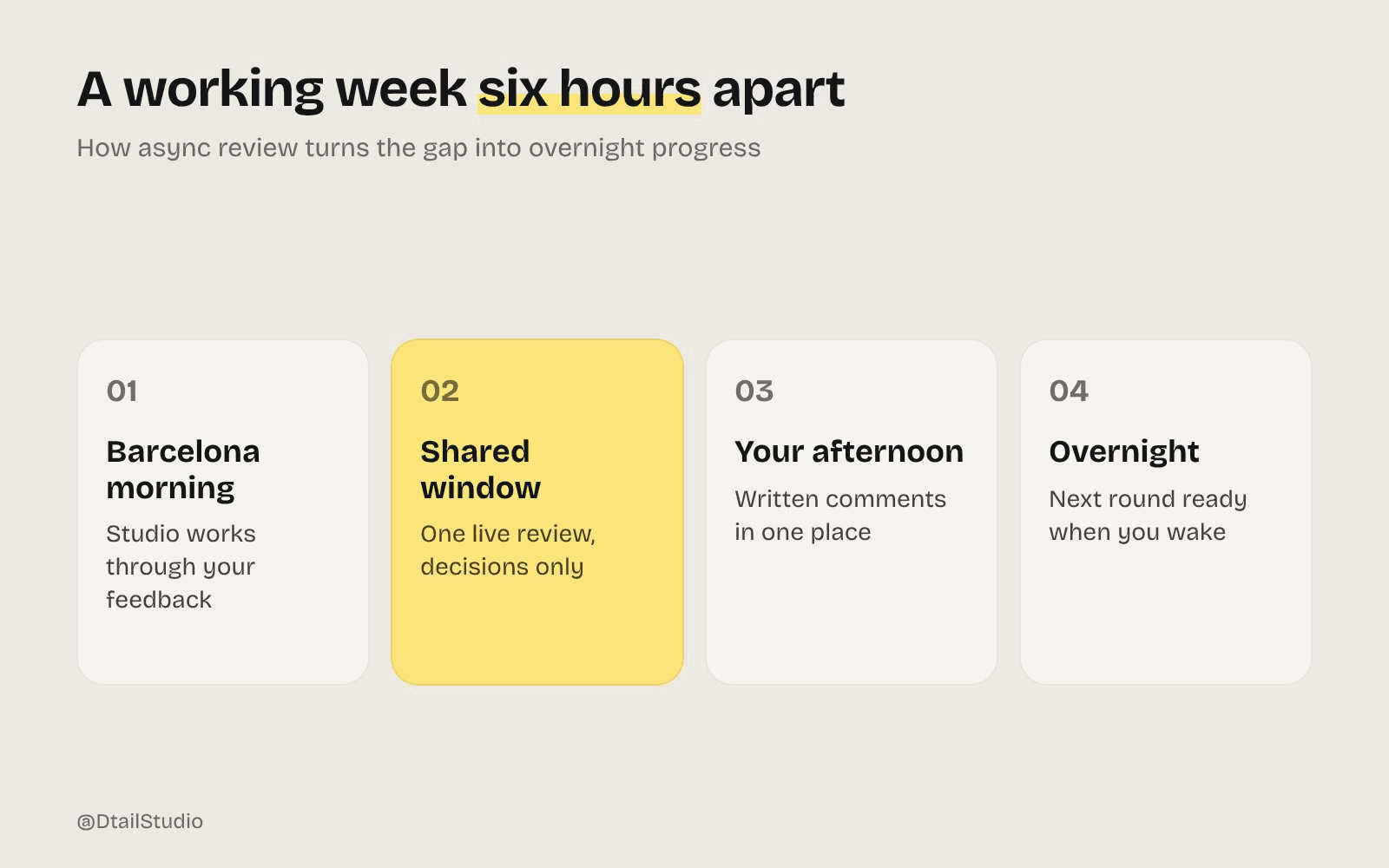
How a US team and a Barcelona studio can split the day. Framework by Dtail Studio.
Not if you plan for it. Six hours between New York and Barcelona gives you about three shared working hours and a team that keeps going while you sleep. Barcelona runs on Central European Time, six hours ahead of New York for most of the year. At 09:00 in New York it’s 15:00 in Barcelona, so two 09:00 to 18:00 days overlap from 09:00 to 12:00 New York time. For about a week each autumn the gap is five hours, because Europe and the US change their clocks on different Sundays.
Set up well, the week runs like this:
Barcelona morning.
The studio works through yesterday’s feedback with nobody waiting on a call.
The shared window.
One live review at 09:00 or 10:00 your time, for decisions only.
Your afternoon.
Your team leaves written comments on the files, in one place.
Overnight.
The studio picks them up first thing, and you wake up to the next round.
The West Coast is harder. At 09:00 in San Francisco it’s 18:00 in Barcelona, so someone joins early or late. Studios with people on both sides cover this with a contact in US hours, which is why our own team is split between Barcelona and California. Ask how it works before you sign.
Where it breaks is research. If the product needs daily live sessions with US users, such as nurses testing a clinical workflow every afternoon (an illustrative case), hire close to the users or make sure the studio has researchers in your time zone.
Who owns the work, when you pay, in which currency, and which country’s law applies if something goes wrong. This isn’t legal advice, and your lawyer should read the contract. These are the points to raise before it gets to them:
IP assignment.
All rights in the final work should transfer to your company in writing once you’ve paid. Include source files, not only exports, and ask which fonts, photos or code libraries need their own licences.
Payment terms.
Milestones tied to deliverables, with dates. Agree what happens to work in progress if either side ends the project early.
Currency.
A quote in euros moves with the exchange rate. On an illustrative $60,000 project, a 5% swing is $3,000. Ask for dollars, or fix the rate for the project.
Governing law.
This decides which country’s rules and courts settle a dispute. Many European studios propose their own. That can be fine. Know it before you sign, and agree to try mediation first.
Confidentiality and data.
An NDA covering your product, users and investors. If the studio will see personal data from US users, agree who can access it and where it’s kept.
The team.
Name the senior people in the contract, so the team you met is the team you get.
When the work depends on being in the room with US users, buyers or partners every week. That usually means one of these:
Daily research or co-design sessions with US users.
A launch with a lot of in-person production in the US, like a shoot or an event.
A product team that runs on back-to-back live calls and won’t change.
A West Coast team that won’t do early mornings, and a studio with nobody in US hours.
If none of those apply, choose on portfolio, people and process. Location comes after.
We’d agree the shape of the week before anyone opens Figma. For a US team working with a studio in Europe, that usually means:
A kickoff in the shared window.
Goals, decision makers, and who signs off what.
One written brief and one feedback channel.
A single place for comments, so nothing gets lost between time zones.
One weekly live review, plus recorded walkthroughs.
A short video for each design round, so you review on your own time.
A contact in US hours.
Someone who can join a call with your users, investors or engineers when it matters.
A handover your team can use without us.
Source files, components and notes, with IP transferred on payment.
Bring your goals and the people who will approve the work. More on how we work.
Do European studios understand US users?
Good ones have worked with US clients for years. Ask for US case studies and who ran the research.
Should we pay in dollars or euros?
Dollars keep your budget fixed. If the studio invoices in euros, agree the rate up front or keep a buffer.
Can we still run live workshops?
Yes. Book them in the shared morning window, or bring everyone together for the kickoff, where it counts most.
Is a European studio slower?
Not if feedback is written and quick. Most delays come from a review nobody owns.
Look at last week’s design and product calls. Count how many needed everyone live, and how many could have been a recorded walkthrough with written comments. If most could, the time difference will work for you. If most couldn’t, fix that first, whoever you hire.
If you’re weighing a studio in Europe for your next round of design work, let’s talk.
About the author: Alma Johnson is Content Lead at Dtail Studio and writes about brand strategy, positioning and how founders explain what they do.
Sources: Bureau of Labor Statistics, Employer Costs for Employee Compensation, June 2026 (September 2026), Bureau of Labor Statistics, Occupational Outlook Handbook: Web Developers and Digital Designers, Forbes España, Los costes laborales en España suben un 3,5% en 2025 (Eurostat data, March 2026), European Central Bank, Euro reference exchange rate: US dollar, Zeitverschiebung.net, Time in Barcelona, Fortune, Daylight saving time and the one-hour gap between the US and Europe (October 2025)
Digital health app design for Europe and the US: one core product with local layers for language, units, dates, consent and trust cues.

Looking for a climate tech design agency? Eight studios with real climate and energy work, the criteria we used and what to ask before you hire.

HealthTech pitch deck design: show who pays, your evidence, a one-line regulatory path and how patient data is handled. What investors look for.