Digital health app design for Europe and the US
Digital health app design for Europe and the US: one core product with local layers for language, units, dates, consent and trust cues.
27 Oct 2026
Brand identity for startups at Seed: name check, logo, colour, type, voice and templates, plus what can wait until Series A.

At Seed, a brand identity for startups needs a checked name, a logo, a small colour palette, one or two typefaces, a short voice guide, and templates for your deck and website. A full brand book, illustration, motion and sub-brands can wait until Series A, when you know your market and have people to use them.
An illustrative Monday. The founder sends the deck from one template, the sales lead sends a one-pager from another, and the website uses a shade of blue nobody remembers choosing. None of it is wrong. It just looks like three small companies sharing an office.
Bigger companies have the same problem. In the Lucidpress report on brand consistency, based on more than 450 respondents, 60% of companies said they deal with off-brand content, and respondents put the revenue gain from consistent branding at 10 to 20%. That’s a self-reported estimate rather than a controlled study, but the pattern will feel familiar.
At Seed, the fix is a short kit that everyone actually uses.
The parts people meet every week: your name, logo, colour, type and voice, plus the deck and website they see you through. Investors, first customers and early hires judge you on those. At Seed there’s rarely a marketing team, so the identity has to survive someone in a hurry making a slide at 11pm. Usually a founder. Sometimes us.
The brand itself starts before any design work. Our post on why your brand already exists covers how to find it.
Seven items, in the order we’d tackle them.
Name check.
Search the trade mark registers in each market you plan to sell in, then domains and social handles. Filing costs little next to a forced rename: the USPTO base fee is USD 350 per class, the EUIPO charges EUR 850 for one class online, and GOV.UK says a UK trade mark costs at least GBP 205. An hour with a trade mark lawyer is money well spent.
Logo.
A wordmark and a symbol that still read at favicon size and on a dark slide. One colour version, one mono.
Colour.
One main colour, one accent and a set of neutrals, with the codes written down in one place. Check text contrast before you fall in love.
Type.
One or two typefaces, licensed for web and app. Type carries more personality than most founders expect, and our post on how typography shapes brand identity shows why.
Voice.
Half a page: how you sound, words you use, words you avoid, and the one sentence that says what the company does.
Deck template.
Title, section, chart, team and quote slides in your colour and type. This is where most off-brand material is born.
Website template.
A homepage and a page layout your team can edit without a designer. Keep the copy short, since most startup websites explain too much.
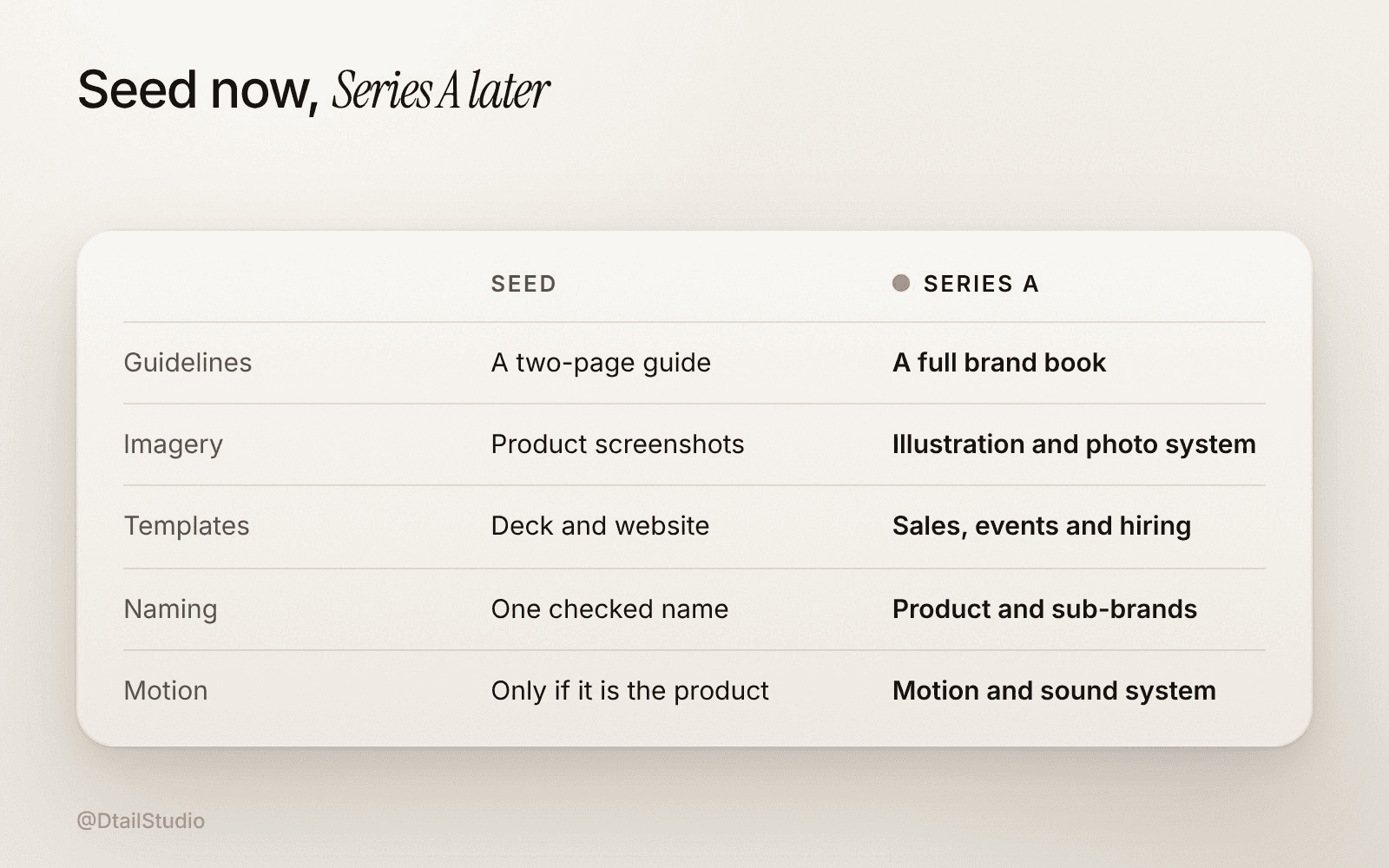
What to build at Seed and what can wait until Series A. Framework by Dtail Studio.
Anything that depends on knowing your market, your team size or your second product. Usually:
A full brand book.
Sixty pages nobody reads when you’re ten people. Two pages do the job.
Illustration and photography systems.
Worth it once you publish a lot. Until then, clean product screenshots work fine.
Motion and sound.
Unless motion is part of the product.
Sub-brands and product naming.
You have one product. Let it carry the company name for now.
Merchandise and event kits.
Nice to have, and the first thing redone after a rebrand.
We’d skip the big brand book at Seed and spend that money on templates, even though designers (us included) do love a thick brand book. A template gets used every day. A book gets opened at the kickoff and then lives in a shared drive. By Series A you’ll know what to keep, and the brand will need to flex as you scale.
Yes, because early investors and buyers only see a few pieces of you, so each one counts for more. A large company spreads its brand across many teams and channels. A Seed startup has fewer channels and fewer chances: a deck, a site, a demo, maybe a one-pager.
If those look like one company, you come across as a team with a plan. If they don’t, people notice before they can say why. Our post on whether your pitch deck is killing your raise covers the deck side of this.
One idea that repeats from the deck to the product. For Cubee, an energy management startup, the technology was strong but the visual presence was fragmented. The identity rests on a geometric symbol system built on energy flow and connection, with grid logic and typography that let it scale across decks, digital screens and physical products. Cubee has 2,000+ installations.
“Dtail helped us launch with a brand and product that stood out instantly,” says David Vondracek, Founder and CEO. The Cubee case study shows the system, and our post on how to brand a clean energy startup goes further into that sector.
We’d start with the name and the deck, because those reach investors first. For a Seed company, that usually means:
Check the name.
With your lawyer, in every market on your plan.
Find the one idea.
A sentence about what you do and for whom, which drives every visual choice after it.
Design the core kit.
Logo, colour, type and voice, tested on real slides and screens.
Build the templates.
Deck, website and the one-pager sales keeps asking for.
Write a two-page guide.
With do and don’t examples your team will actually check.
Bring your current deck, the names you’re considering and a few brands you admire, with a line on why. More on how we work.
How much should a Seed startup spend on brand identity?
Enough to do the checklist properly, and no more. Prices vary widely by region and studio, so compare quotes on the same scope.
Can we use an AI logo generator?
For a placeholder, yes. Check that you can own and register the result, and expect to replace it.
Should we rebrand before Series A?
Only if the name has a legal problem or the brand tells the wrong story to the buyers you now sell to. Otherwise, tidy up and keep going.
Who should own the brand in a small team?
One person, usually a founder. When everyone owns it, everyone edits the template.
Put your deck, homepage, LinkedIn page and latest sales email side by side. Count the colours, the typefaces and the ways you describe the company. If any count is above two, fix that before you design anything new.
If you’d like a second opinion on your kit, let’s talk.
About the author: Alma Johnson is Content Lead at Dtail Studio and writes about brand strategy, positioning and how founders explain what they do.
Sources: Lucidpress, The state of brand consistency (2021), USPTO, How much does it cost?, EUIPO, Fees and payments, GOV.UK, Register a trade mark
Digital health app design for Europe and the US: one core product with local layers for language, units, dates, consent and trust cues.

A design system for startups pays off later than most founders think. The signs you need one, the smallest useful version and what can wait.

Thinking of a design agency in Europe for your US startup? Real cost and time-zone numbers, what the contract should cover, and when to stay local.