Designing tech for older adults that doesn’t feel like a pill box
How to design apps for older adults that are accessible and dignified, not patronising. Principles, a swap table and lessons from the Elli Cares app.
13 Oct 2026
Seven questions that separate a real HealthTech design partner from a nice portfolio, with what good answers sound like and the red flags to watch.

Choose a studio that has shipped products for real patients or clinicians, asks about your intended use and your data before it asks about colours, designs for your least able user first, and is as proud of an error screen as of a hero shot. Look at the portfolio second. Ask the seven questions below first.
A beautiful health app that a nurse can’t use on a shared workstation isn’t a beautiful health app. It’s a liability with nice gradients.
Choosing a design partner is hard in any industry. In HealthTech, the people on the other side of the screen are different. A clinician with 40 seconds between patients. A 78-year-old managing six medications. A parent holding a nervous child still for an X-ray. And behind them, procurement teams and compliance officers who read your interface like a contract.
At Dtail Studio, a Barcelona design studio working with HealthTech and renewable energy startups, we’ve designed the Elli Cares app for people living with dementia and worked as the brand team for OXOS, the company behind the FDA-cleared MC2 portable X-ray system. These are the questions we’d ask if we were sitting in your chair.
Three things: who uses it, who signs it off, and what happens when a screen is confusing. In most products, bad UX costs you conversions. In health, it can cost someone a missed dose.
That changes the work in practical ways:
Users are often under stress or have reduced abilities. Low vision, tremor, memory loss, gloves, bad lighting, no time.
Regulation shapes the interface. If your product is a medical device, including software that qualifies as one, regulators expect evidence that real users can use it safely. In the US that’s the FDA’s human factors guidance. In Europe it’s the Medical Device Regulation and the IEC 62366-1 usability standard. We’ve written more on why HIPAA, MDR and accessibility make healthcare UI better.
The buyer isn’t the user. A hospital buys, a nurse uses, a patient lives with the result. Each needs a different kind of reassurance.
Your designers don’t need to be regulatory consultants. They need to design in a way your regulatory people never have to undo.
Which health products have you shipped, and who used them?
Good answer: names a product, a user group and one constraint they designed around.
Red flag: “We’ve done lots of wellness apps.”
What do you need to know about our intended use and data before you start?
Good answer: asks about claims, classification, who sees what data, and where.
Red flag: goes straight to moodboards.
Who is our hardest user?
Good answer: describes the least able person in your audience and designs for them first.
Red flag: “Our users are pretty tech savvy.”
How do you handle accessibility?
Good answer: treats WCAG 2.2 AA as the floor and tests with real users.
Red flag: “We can add that at the end.”
Can you show me an error state you’re proud of?
Good answer: shows the boring screens with the same care as the hero.
Red flag: only shows Dribbble shots.
Who will actually do the work?
Good answer: the same senior people in the pitch and in the files.
Red flag: partners pitch, juniors deliver.
What do we own at the end?
Good answer: a design system, source files and guidelines your team can run.
Red flag: locked files and a vague handover.
Question 2 tells you the most. A studio that asks “what are you allowed to claim on this screen?” in the first call has done this before.
You need a great agency that has already made its healthcare mistakes on someone else’s budget. Experience shortens discovery and saves you from the “wait, nurses share logins?” moment in month three.
Experience isn’t copy and paste, though. Every product has its own users, claims and risks. Ask a specialist how they would adapt their last project to yours. If the answer is “we’d do the same thing”, keep looking.
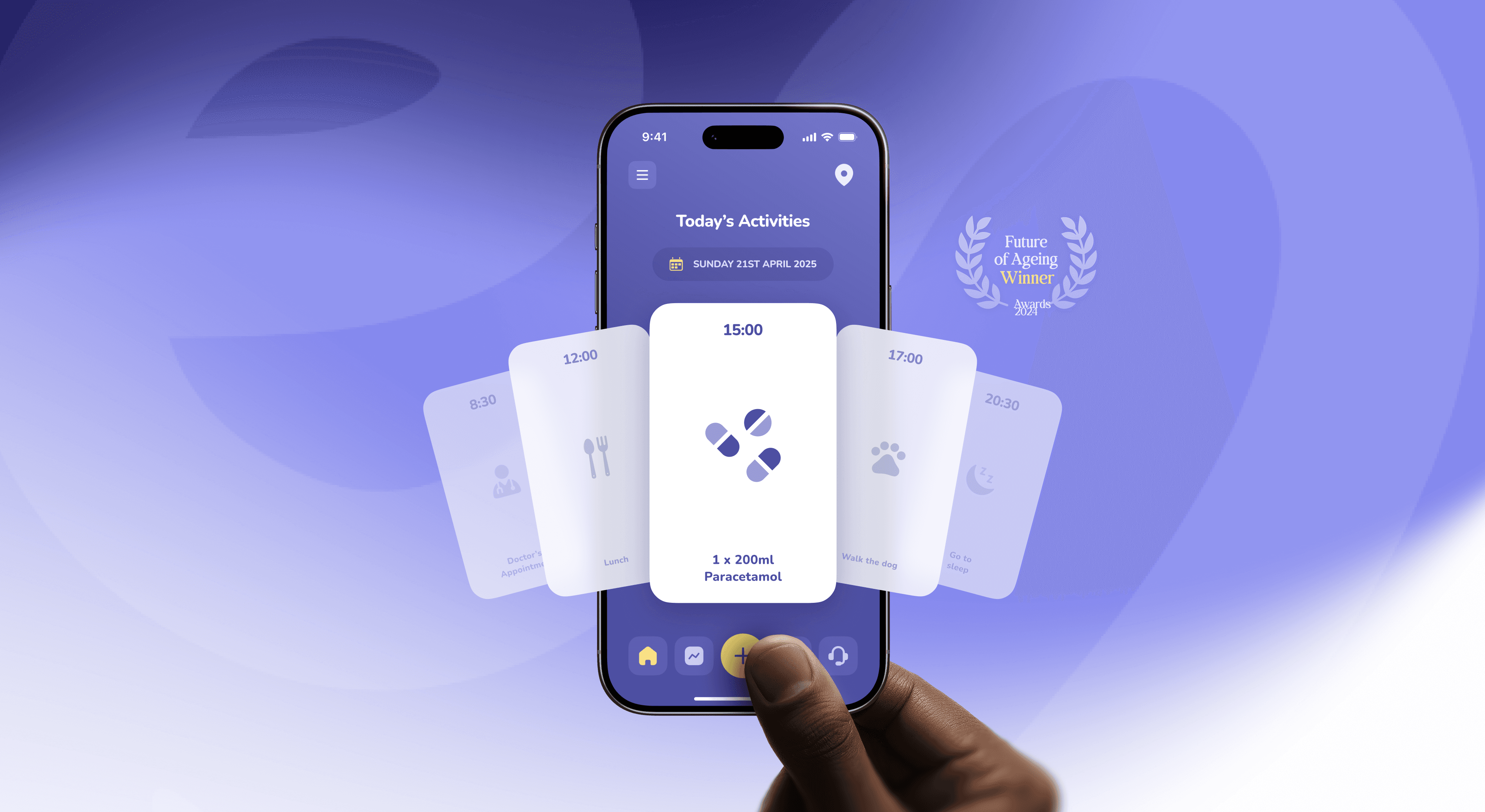
Elli Cares helps people living with cognitive impairment stay independent, and gives their families peace of mind. When we started, the app carried high cognitive load, low contrast and unclear hierarchy. For someone living with dementia, that turns a medication reminder into a puzzle. We simplified the flows, raised contrast, built a calm visual language and redesigned reminders, mood tracking, scheduling, location sharing and family communication (see the case study). We wrote up the principles in designing an app for people living with dementia. Elli Cares is now used in 19 countries, was a joint winner of the 2024 Future of Ageing Award and is nominated for the 2026 SilverEco and Ageing Well Awards.
“Working with Dtail felt like having a senior team that truly cared about results and users.” Angela Edwards, CEO, Elli Cares
OXOS makes the MC2, a lightweight, wireless X-ray system whose FDA clearance was expanded to paediatric imaging in March 2026. When the product is a device that emits radiation, the brand can’t just look good. It has to make a surgeon, a hospital buyer and a parent feel the same thing: this is safe, and these people know what they’re doing.
“A team that feels like an extension of our own. Dtail Studio understands OXOS so well it’s like having an in-house brand team.” Evan Ruff, Founder and CEO, OXOS
The lesson from both: in health, a brand works like a promise. Every screen, email and box either keeps it or breaks it.
A wellness portfolio presented as healthcare experience. Meditation apps don’t make medical claims.
No questions about who can see which data.
Accessibility sold as an optional extra.
Streaks, guilt notifications and other engagement tricks in their past work. Fine for a language app. Not for medication adherence.
One interface for everyone, when your product clearly has two kinds of user. More on that in designing for patients and the families who care for them.
A fixed price for a regulated product before anyone has looked at your intended use.
No. Wellness apps for sleep, fitness or meditation usually make no medical claims. Once a product diagnoses, treats or monitors a condition, or handles patient records for providers, the rules change what you can design and say.
Enough to design with them: who sees what, how access is logged, how claims are worded, how accessible the interface is. Your regulatory advisor owns the details.
WCAG 2.2 level AA is the usual baseline: 4.5:1 contrast for body text, keyboard and screen reader support, and no information carried by colour alone. For older or cognitively impaired users, aim well above it.
Formal validation studies are usually run with human factors specialists. A good design partner designs for that study from day one and works alongside the people running it. Ask how they have done that before.
Print the questions above and take them into the meeting. The answers to questions 2 and 5 will tell you more than any case study.
Building something in HealthTech? We’re always happy to take a look.
About the author. Slavena Vasileva is a partner and brand strategist at Dtail Studio, a senior brand and product design studio in Barcelona working with HealthTech and renewable energy startups. 16+ years, 300+ products, 5.0 on Clutch.
Sources: FDA human factors guidance · EU MDR 2017/745 · WCAG 2.2 · Inside Ageing on Elli Cares · Diagnostic Imaging on OXOS MC2
How to design apps for older adults that are accessible and dignified, not patronising. Principles, a swap table and lessons from the Elli Cares app.

Energy investors read a climate deck differently. What they look at first: technology readiness, unit economics, real installs and impact with a method.

Patients want independence, carers want reassurance. How to design one health app that serves both without turning care into surveillance.