The best design agencies by industry in 2026
Hand-picked design studios for 14 industries, from SaaS and HealthTech to fashion and public services, with real projects you can check.
20 Oct 2026
What a HealthTech startup design agency should do in the first 30 days: listen, agree a brief, test the riskiest flow and hand over something real.

In the first 30 days, a good HealthTech startup design agency learns your users, tests your riskiest flow with real people, agrees one clear brief with you and ships something you can use, such as a redesigned key screen or a clickable prototype. If the first month is only workshops and moodboards, the partnership is starting in the wrong place.
You’ve signed. The kickoff call is booked. Now what?
Most founders have hired engineers before. Fewer have hired a design partner, so they don’t know what a good first month looks like, and they find out around week six that they’re paying for a lot of discovery and very little product.
The first month should leave you with something real. You shouldn’t have to wait for month three to find out whether the partnership works.
Because the first month sets the habits of the whole project: what gets tested, who decides and how fast. It’s also when you still have the energy and the budget to change direction.
Design does pay back when it’s done well. McKinsey tracked the design practices of 300 listed companies over five years. Top-quartile companies had 32 percentage points higher revenue growth and 56 points higher shareholder return growth than their industry peers. Those are big companies, not seed startups, but the habits McKinsey measured, such as testing early and treating design as more than a phase, start in month one.
In health, the cost of getting it wrong is high. In a JMIR study of mental health apps, median 30-day retention was 3.3%. A first month spent polishing screens nobody keeps using is an expensive month.
Week one is for listening: your users, your data and your constraints. Expect a lot of questions, many of them uncomfortable.
Your users, in their words.
Interview notes, support tickets, pilot feedback, app reviews. A good partner reads everything before forming opinions.
Your product as it is today.
A walkthrough of the live product or prototype, including the bits you’re embarrassed about. Those are usually the most useful.
Your constraints.
Regulation, clinical sign-off, integrations, the investor meeting in six weeks. Design that ignores these gets redesigned.
By the end of week one, your partner should be able to describe your product, your users and your next milestone in plain words. If they can’t, say so then, not in week four.
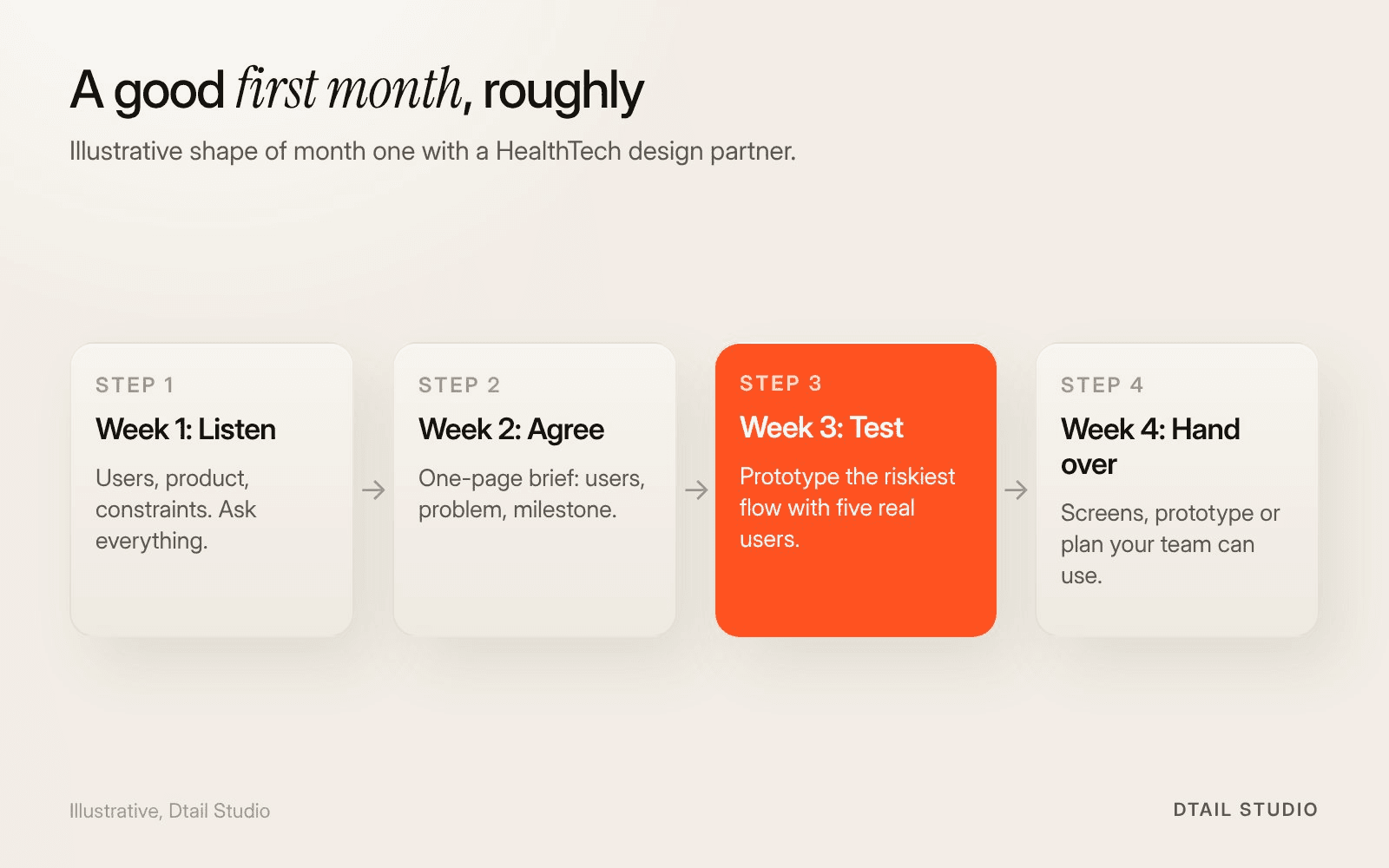
The shape of a good first month. Illustrative, by Dtail Studio.
By week two you should have a written brief you both agree on, and by week three your riskiest flow should be in front of real users. The sketch in the figure shows the shape we think a good first month takes. It’s illustrative, not a contract.
Testing early doesn’t need a big study. Nielsen Norman Group’s well-known finding is that five users uncover about 85% of usability problems in a round. In health, those five should be the right five: patients, caregivers or clinicians, not your colleagues.
Our point of view: test the flow that would hurt most if it failed, not the one that’s easiest to make pretty. For most health products that’s onboarding, consent or the first time someone logs a result. Our post on onboarding, consent and permissions covers that first minute in detail.
Something you can use without the agency in the room. Depending on your stage, that’s one of these:
A redesigned key screen or flow,
tested with users, with notes on what changed and why.
A clickable prototype
you can put in front of a pilot site or an investor.
A short design direction
for the brand or product, with real screens, not only a moodboard.
A prioritised list of what to fix next,
with the reasons, so your own team can start on it.
If your partner has done this before, they’ll also tell you what they’d stop doing. That’s often the most valuable page in the month.
We’d treat the first month as a test of the partnership, for both sides. For a HealthTech team, that usually means:
Read everything, then interview users.
We start with your material and a handful of conversations with the people who use the product.
Agree one brief.
One page: users, problem, milestone, what success looks like. Everyone signs it off.
Test the riskiest flow.
Prototype it and put it in front of real users before polishing anything.
Hand over something real.
Screens, a prototype or a plan your team can act on, plus an honest view of what we’d do next.
Bring access to your product, any user research or pilot feedback, and the date of your next milestone. More on how we work. If you’re still choosing a partner, our post on what to send a design agency before the first call will save you a meeting, and our healthcare UX design agencies in Europe list compares seven studios.
When we started with Elli Cares, an app for people living with cognitive impairment and their families, the problems were high cognitive load, low contrast and an unclear hierarchy. The case study shows what we changed.
How much of the first month is research?
Less than you’d think. A week of listening, then research continues alongside design through testing.
Do we need a full brand before product work starts?
No. Start where the risk is. Brand can follow the product, or run alongside it.
What should we do in the first month?
Make decisions quickly, share everything you have and put the agency in touch with real users. The biggest delays in month one are almost always access.
What if the first month isn’t working?
Say so early. A good partner would rather change course in week two than finish a month nobody’s happy with.
If you’ve just hired a design partner, or are about to, write down the one thing you want to hold in your hand on day 30. A prototype, a tested flow, a direction. Send it to them before the kickoff and ask them to tell you plainly whether it’s realistic. Their answer tells you a lot about the next six months.
If you want to compare notes on your first month, let’s talk it through.
About the author: Alma Johnson is Content Lead at Dtail Studio and writes about brand strategy, positioning and how founders explain what they do.
Sources: McKinsey, The business value of design (2018), Baumel et al., Objective User Engagement With Mental Health Apps, JMIR 2019, Nielsen Norman Group, Why you only need to test with 5 users
Hand-picked design studios for 14 industries, from SaaS and HealthTech to fashion and public services, with real projects you can check.

Seven healthcare UX design agencies in Europe with real health case studies, how we chose them and how a founder should compare them.

Check a design agency like an investor: verified reviews, client calls, who does the work, real results, returning clients and contract basics.