

Digital health app design for Europe and the US
Digital health app design for Europe and the US: one core product with local layers for language, units, dates, consent and trust cues.
27 Oct 2026
A design system for startups pays off later than most founders think. The signs you need one, the smallest useful version and what can wait.

A design system for startups pays off when a second designer joins, when engineers keep rebuilding the same parts, or when you launch a second product or a white-label version. Before that, most Seed teams need a small style guide: design tokens, about twenty components and one page of rules, built from screens you’ve already shipped.
Here’s an illustrative scene you may recognise. A Seed startup has one designer, five engineers and a Figma file with four shades of almost the same blue. Someone reads about design systems. Six weeks later there’s a lovely component library, a documentation site and a product that hasn’t changed at all.
The ambition is right. The timing usually isn’t. Design systems are mostly a big-company habit: in Sparkbox’s 2021 survey, only 10% of in-house respondents with a design system worked at organisations of 1 to 50 people, while 47% worked at organisations of more than 2,000. They also take people. The zeroheight Design Systems Report 2025 puts the average design system team at companies under 100 employees at three people. For an illustrative fifteen-person startup, that’s a fifth of the company looking after buttons.
The good news is that a first system rarely starts from a blank file. The best ones grow out of the screens you’ve already shipped.
When inconsistency starts costing engineering time. A messy Figma file is a design problem. Slower releases are a business problem. These are the four signs we look for:
A second designer joins.
Two people, two ways of drawing a card. Before long the product looks like it was made by two companies.
Engineers rebuild the same parts.
If a code review asks “which grey?”, or a modal exists in three versions, you’re paying for the same work twice.
A second product, platform or white-label version is coming.
A native app, a partner version with someone else’s logo, an installer tool next to a consumer app. Shared tokens let you change the skin without rewriting the product.
Brand and product have drifted apart.
The deck, the website and the app look like three different companies, which gets awkward when an investor sees all three in one afternoon.
If none of these sound familiar, you probably don’t need a system yet. And if your core flows still change every month, a system will only freeze decisions you haven’t finished making.

The smallest useful system covers one product team. Framework by Dtail Studio.
Tokens, about twenty components and one page of rules, with one person who owns them.
Design tokens.
Named values for colour, type, spacing and corner radius, used by the same name in Figma and in code. They’ve gone mainstream: in the zeroheight report, design token use rose from 56% in 2024 to 84% in 2025 among the teams surveyed.
About twenty components.
The parts on your five most-used screens: buttons, inputs, selects, cards, table rows, tabs, modals, toasts, empty states and menus. Skip the ones you might need one day.
One page of rules.
When to use a primary button, how error messages are written, how the spacing grid works. One page people read beats fifty pages nobody opens.
One owner.
Usually your lead designer, with an engineer as partner. Someone has to say no to the fifth button style.
We’d always build it from shipped screens. A component that hasn’t met a real user is a guess with a name. Collect what’s live, merge the duplicates, and you have a system that matches your product on day one.
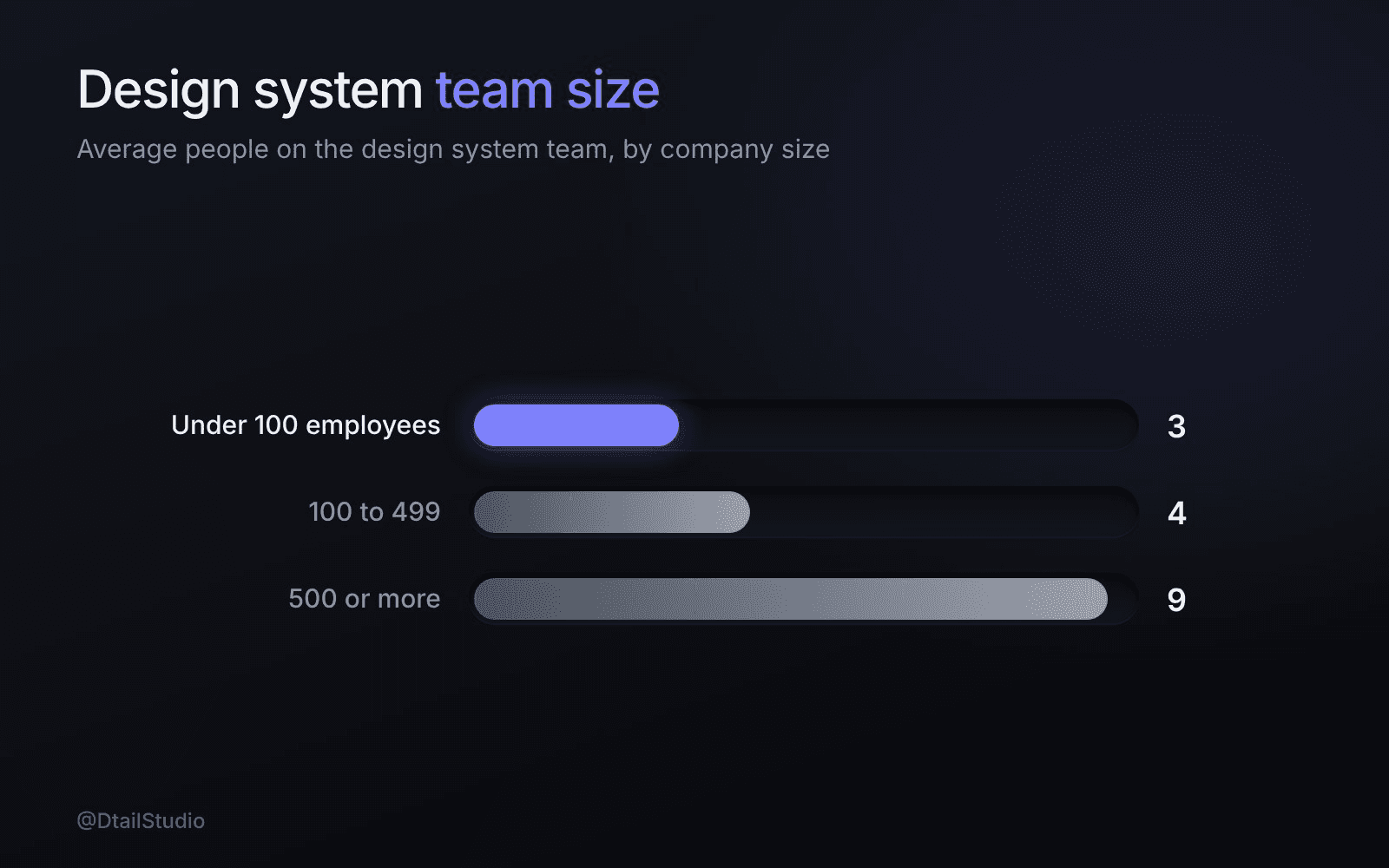
Average design system team size by company size. Source: zeroheight Design Systems Report 2025.
Mostly focus, because someone has to keep it current, and at a startup that someone is usually your only designer. The payoff is real when the system is up to date. In a controlled test by Figma’s data science team, designers with a design system finished their task 34% faster than when they worked from old design files. Figma itself expects 34% to be the most you’d save in real life, because the system in the test was relevant and current.
That condition is the cost. A system that lags behind the product is worse than none, because people stop trusting it and quietly build around it. In Sparkbox’s 2022 survey, technical and creative debt was the challenge maintainers named most often (43%). Staffing was named as a challenge by 35% of maintainers, but as a priority by only 13%.
So budget for it. A minimum system costs a focused stretch of your designer’s time, then a few hours a week. A full system, with a documentation site, themes and versioned releases, costs a team.
Anything that serves teams you don’t have yet. At Seed, all of these can wait:
A public documentation site. A shared Figma page is plenty for one team.
Themes for every brand and mode, unless a white-label version is on this year’s roadmap.
Contribution processes, governance and versioned releases.
A dedicated design system team.
Rare components. Build them the second time you need them.
The best SaaS products feel simpler as they grow because someone keeps removing things, and a small system makes removing things easier. A big one built early is one more of the things that break when you scale too soon.
A few rules applied everywhere, rather than a library of everything. For Cubee, an energy management startup, our work included a grid logic and a typography system, and the identity had to scale across decks, digital and physical.
That’s the minimum system idea at brand level: a few decisions, made once, used everywhere. The Cubee case study shows how the pieces fit together.
We’d start from what you’ve shipped and keep the first version small. For a Seed or Series A product, that usually means:
A screen inventory.
Every live screen, with the variants counted: buttons, greys, font sizes, spacing. The count tells you how much drift you have.
Tokens first.
We name colour, type and spacing values and agree them with your engineers, so Figma and code use the same names.
The core twenty.
Components from your most-used screens, duplicates merged, each matched to its coded version.
One page of rules and an owner.
Usage and writing rules, plus who approves new components.
Bring your Figma files, access to the codebase, your roadmap for the next two releases and the name of the future owner. More on how we work.
Should a startup use an off-the-shelf UI library?
Often, yes. A well-built open-source library restyled with your own tokens gets you most of the way at Seed. Build custom components only where your product is genuinely different.
Who should own the design system at a startup?
Your lead designer, with one engineer as partner. A committee won’t do it. If nobody owns it, it goes out of date within a few releases.
Can an agency build our design system?
Yes, if they start from your live product and hand it over to an owner on your side. Our guide to choosing a design agency for SaaS covers what to check.
Will a design system slow us down?
A big one built too early will. A small one built from shipped screens should save time from the next release on, because engineers stop guessing.
Open your five most-used screens and put screenshots side by side. Count the button styles, the greys and the font sizes. If any count is above three, start with tokens. If buttons alone pass five, you’ve found your first component to merge, and probably settled your first argument.
If you’d like a second pair of eyes on your product, let’s talk.
About the author: Rori Thompson is a Content Writer at Dtail Studio and writes about product design, UX and the details that make an app easy to use.
Sources: Sparkbox, 2021 Design Systems Survey, Sparkbox, 2022 Design Systems Survey, zeroheight, Design Systems Report 2025, Figma, Measuring the value of design systems
Digital health app design for Europe and the US: one core product with local layers for language, units, dates, consent and trust cues.

Thinking of a design agency in Europe for your US startup? Real cost and time-zone numbers, what the contract should cover, and when to stay local.

Looking for a climate tech design agency? Eight studios with real climate and energy work, the criteria we used and what to ask before you hire.