
How to check a design agency before you sign: reviews, references and results
Check a design agency like an investor: verified reviews, client calls, who does the work, real results, returning clients and contract basics.
16 Oct 2026
Researchers tested nine ways to get cited in AI answers. Quotes, statistics and sources won. Keyword stuffing lost. Here’s what it means for your site.

The GEO paper (Aggarwal et al., KDD 2024) rewrote web pages nine different ways and measured how much of an AI answer each version earned. Adding quotations, statistics and cited sources lifted visibility by 28% to 41%. Keyword stuffing lowered it. And the biggest gains went to pages that ranked lower on Google.
A founder types “best HealthTech design studio in Europe” into an AI assistant. It answers with three names and a tidy paragraph about each. Your studio isn’t one of them. Neither is the one that ranks first on Google, which is the interesting part.
For twenty years we learned how to rank. Now there’s a second question: once a page is found, does the AI actually use it? The GEO paper is the first serious attempt to measure that. It was presented at KDD 2024, which happened to take place in Barcelona, our home town. It’s also dense with benchmarks and tables, so here it is with the maths taken out and the useful bits left in.
At Dtail Studio, a Barcelona design studio working with HealthTech and renewable energy startups, we restructured our own journal around these findings this year. This is the version we wish someone had handed us.
They changed one page at a time and watched what the AI did with it. The team, from Princeton, IIT Delhi and two independent researchers, built a benchmark called GEO-bench: 10,000 queries from nine datasets (some written by GPT-4), across 25 topic areas.
For each query they took the top five Google results as the material an AI could draw on. Then they rewrote one of those five sources with one tactic, left the other four alone, and asked a GPT-3.5 answer engine to respond. Key results were then checked on Perplexity.

Two scores came out of each run. The main one, Position-Adjusted Word Count, measures how much of the answer came from that source, with extra weight for appearing early. The second, Subjective Impression, asks GPT-3.5 to judge things like relevance and influence. Think of the first as column inches and the second as tone of the review.
The ones that gave the AI something worth repeating. Quotations, statistics, fluent writing and cited sources all lifted visibility by more than a quarter.
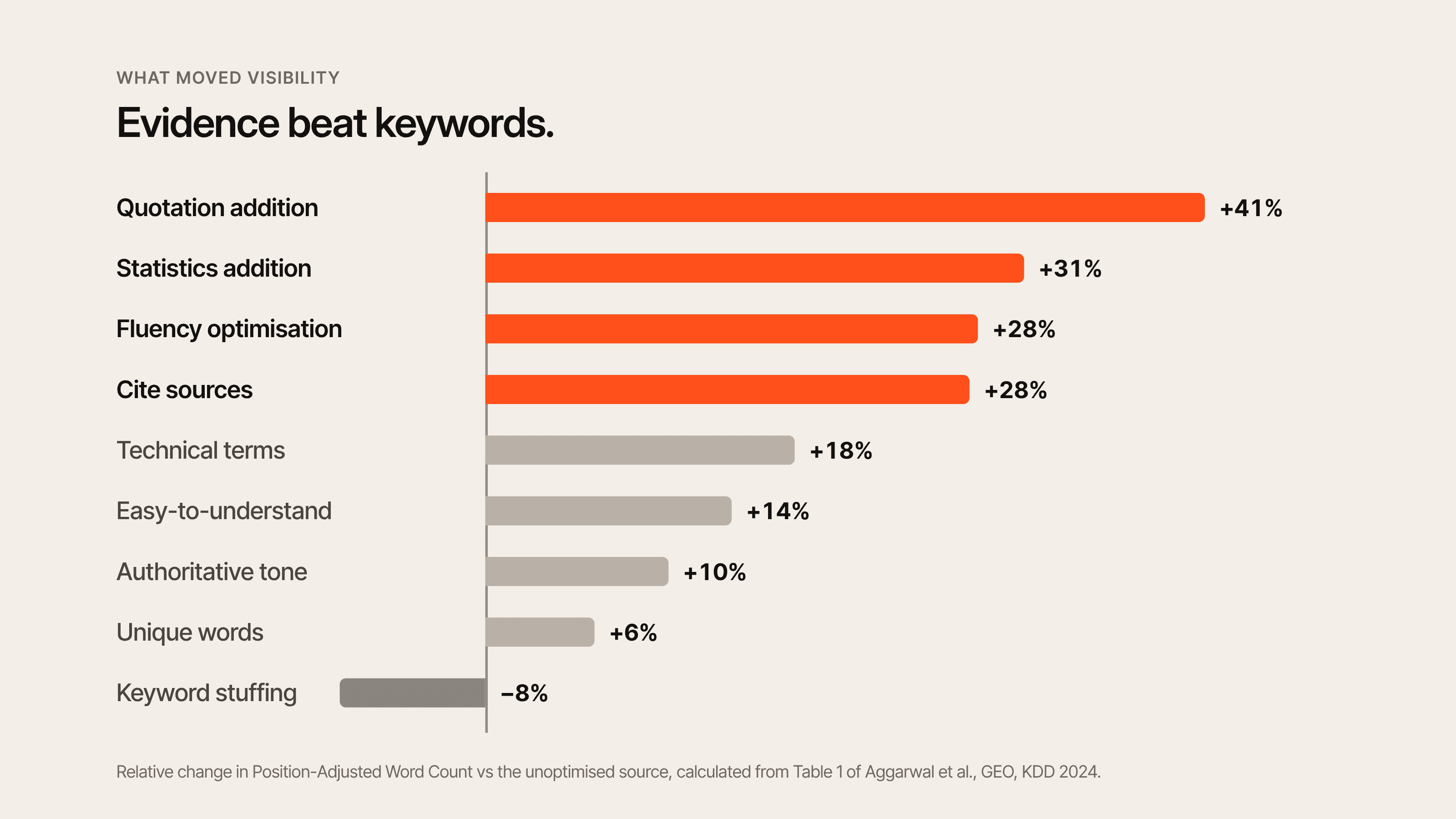
Quotation addition (+41%).
Add a relevant quote from a real, named person. The single strongest tactic on the main score.
Statistics addition (+31%).
Swap vague claims for numbers. “Many users” becomes a real figure, with its source.
Fluency optimisation (+28%).
Make the text read smoothly. No new facts, just better sentences.
Cite sources (+28%).
Name where your claims come from, ideally with a link.
The middle of the table is more modest: technical terms (+18%), easy-to-understand language (+14%), an authoritative tone (+10%) and unique words (+6%) all helped a little. That middle group matters, because a popular summary of the paper lists “easy to understand” as a failure. On the paper’s main score it gained 14%. Simple writing didn’t hurt you. It just isn’t enough on its own.
The paper also tried combinations. The best pair was fluency plus statistics, which beat any single tactic by more than 5.5%. Good writing and hard numbers turn out to be better together, which every editor has been saying for a century.
No. On the main score, stuffing a page with the query’s keywords lowered its visibility by 8%. It was the only tactic of the nine that went backwards.
There’s a small footnote: on the AI-judged impression score it rose slightly, by about 5%. So the AI didn’t mind the page. It just quoted less of it. Which is roughly how people react to keyword-stuffed copy too: polite nod, no quote.
The underdog. Pages that ranked fifth on Google gained far more than pages that ranked first, and the first result often lost ground.
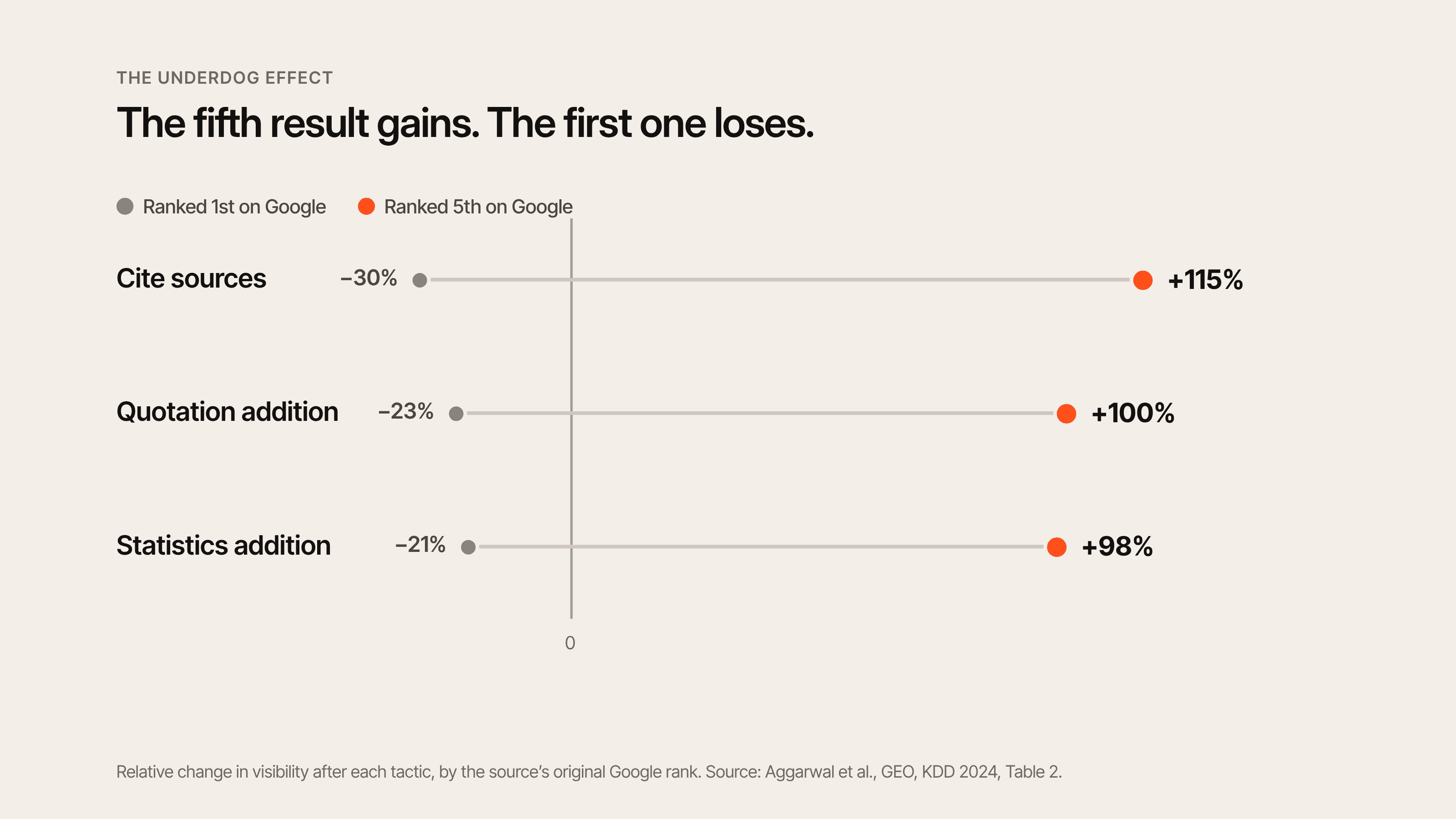
With cited sources, the fifth-ranked page gained 115.1% in visibility, while the top result fell by 30.3%. Quotations (+99.7% versus −22.9%) and statistics (+97.9% versus −20.6%) showed the same pattern.
The paper’s explanation is refreshingly simple. Search rankings lean on things that take years to build, like backlinks and an established domain. An AI answer leans more on what the page actually says. For a startup with a young domain, that’s the most hopeful sentence in the whole paper: you can’t buy ten years of backlinks, but you can write a better paragraph this afternoon.
Usually one paragraph at a time. Here’s the same claim written twice.
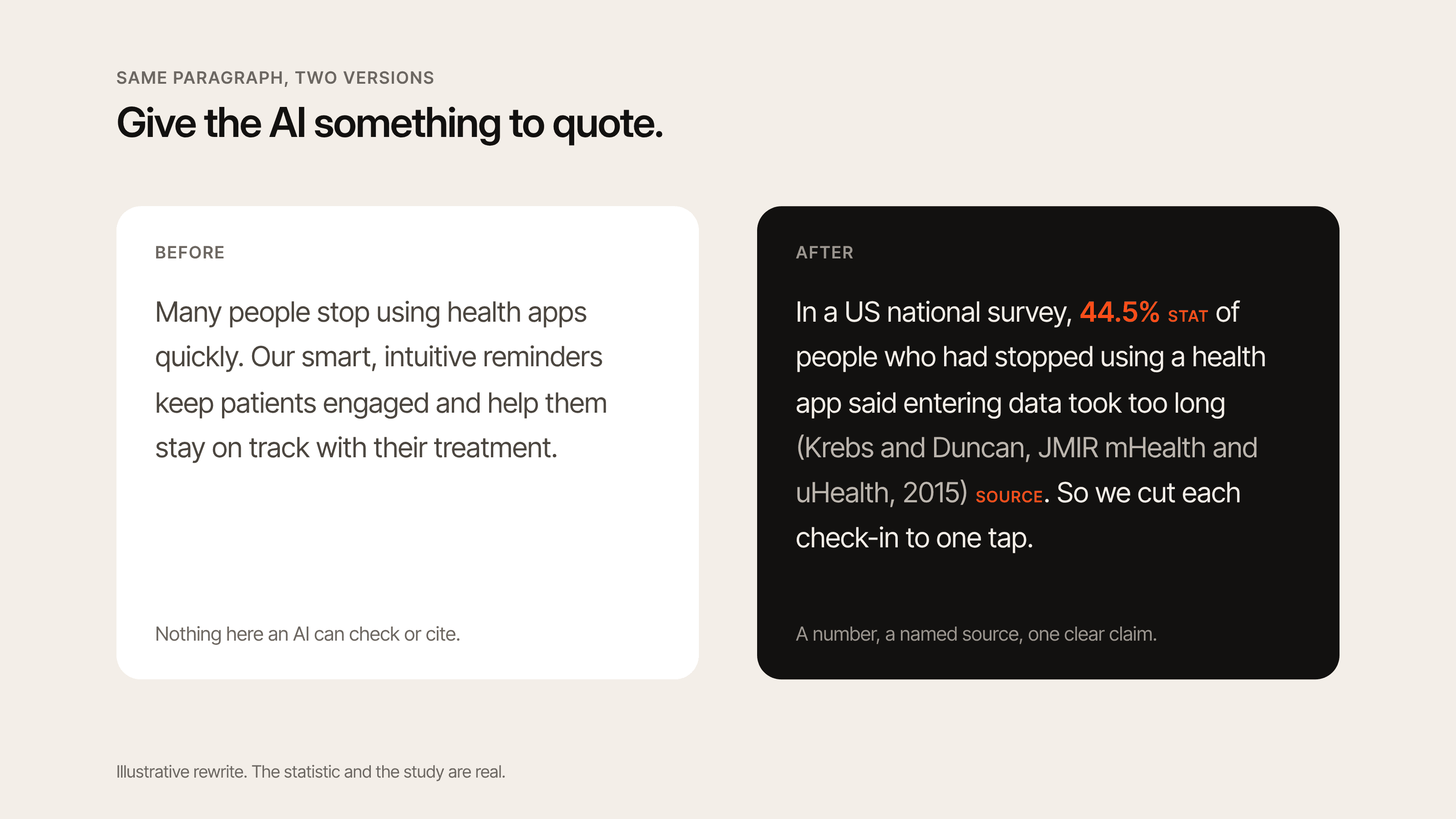
The second version isn’t longer or cleverer. It just contains things an AI can check and repeat: a number, a named study and one clear claim. A quick list for your own pages:
Lead with the answer.
Put a complete, quotable answer in the first two sentences under each heading.
Add one real number per section.
With its source, and only if you’ve opened the page it came from.
Quote a real person.
A customer, a researcher, your own CEO. Named, relevant and accurate.
Link your sources.
Studies, standards, official data. It helps readers and machines alike.
Edit for flow.
Read it out loud. If you run out of breath, so will the reader.
It doesn’t tell you how today’s AI assistants behave. The main tests used a GPT-3.5 answer engine built for the study in 2023, with a smaller check on Perplexity. Real systems have changed since, and they don’t publish their recipes.
It also found that results vary by topic. Authoritative writing did best in debate, history and science queries. Statistics helped most in law and government, debate and opinion. Quotations did best in people and society, explanations and history. So treat the tactics as a menu, not a formula.
And one thing no benchmark measures: whether the quote is real and the number is right. The tactics work because they make a page more useful. A made-up statistic is still made up, and in health or energy it can cost you far more than a citation.
What is generative engine optimisation (GEO)?
Making your content easy for AI answer engines to use and cite. The term comes from the GEO paper by Aggarwal and colleagues, published at KDD 2024.
Is GEO different from SEO?
They work together. In the study, the AI only drew from the top five Google results, so you still need to be found. GEO is about being used once you are.
Which GEO tactic works best?
On the paper’s main score, adding quotations (+41%), then statistics (+31%). The best combination was fluency plus statistics.
Does this apply to ChatGPT and Perplexity?
The paper tested a GPT-3.5 answer engine and confirmed key results on Perplexity. Treat it as strong evidence for the direction, not a guarantee for any one assistant today.
Should I add quotes to every page?
Only real, relevant ones. A quote earns its place when it says something your own sentence can’t.
Pick the page you most want an AI to quote. Open it next to the checklist above and count how many sections have a clear answer, a sourced number and a named person. Then rewrite the weakest section, just that one, and read both versions out loud. You’ll hear which one sounds quotable.
Want a second pair of eyes on it? Let’s talk.
About the author. Slavena Vasileva is Brand Strategist and Partner at Dtail Studio, a senior brand and product design studio in Barcelona working with HealthTech and renewable energy startups. 16+ years, 300+ projects, 5.0 on Clutch.
Sources: Aggarwal et al., GEO: Generative Engine Optimization (KDD 2024, arXiv 2311.09735) · Krebs and Duncan, Health app use among US mobile phone owners (JMIR mHealth and uHealth, 2015)
Check a design agency like an investor: verified reviews, client calls, who does the work, real results, returning clients and contract basics.

Leave it, refresh or rebrand? A decision framework for startups after a Series A, with the signals for each and lessons from the Cubee brand.

Most health apps lose their users within two weeks. The research on why patients drop off, and a design framework to keep them, with lessons from Elli Cares.